

Imagine you're scrolling through a pile of raw gemstones, and one slab catches your eye – a smooth, sea‑foam green stone with delicate white speckles. You pause, wondering where on Earth that lovely hue comes from, and why it feels so calming in your hand.
That stone is amazonite, a member of the feldspar family that’s prized for its soothing colour and gentle energy. In the world of jewellery makers, especially those based here in the UK, knowing its origins helps you tell a richer story to your customers and choose the right source for ethical, high‑quality beads.
Amazonite is chiefly mined in a handful of regions. The biggest deposits lie in the Russian Urals, where deep‑green veins have been worked since the 18th century. Brazil’s Minas Gerais state also yields bright turquoise‑tinged amazonite, a legacy of the country’s long history with semi‑precious stones. Smaller, but increasingly popular, sources include Madagascar’s eastern highlands and the United States’ Colorado Front Range, where hobbyist miners often find pocket‑sized crystals.
For craft enthusiasts, the difference matters. Russian amazonite tends to have a slightly darker, more forest‑like tone, perfect for grounding pieces or statement necklaces. Brazilian amazonite, with its lighter, almost minty shade, works beautifully in boho‑style bracelets that need a pop of fresh colour. If you’re after a truly unique find, consider Madagascar’s speckled varieties – they often carry subtle inclusions that add depth to pendant designs.
When you order from a specialist supplier like Charming Beads, you can browse the Amazonite Beads collection and instantly see the origin notes attached to each product. This transparency lets you match the stone’s provenance with the story you want to tell – whether you’re writing a product description about the Russian mines or highlighting the ethical sourcing practices of Brazilian farms.
Here’s a quick checklist for jewellery designers who want to source amazonite responsibly: 1) Verify the supplier lists the country of origin; 2) Ask for any certification confirming ethical mining; 3) Choose bead sizes that showcase the stone’s colour without excessive polishing, which can strip its natural character; 4) Pair the stone with complementary metals – rose gold or brass amplify its warm undertones; 5) Share a short origin note on your product page to engage customers who love the story behind their jewellery.
TL;DR
Amazonite is mined primarily in Russia’s Urals, Brazil’s Minas Gerais, Madagascar’s eastern highlands, and the United States (Colorado), giving designers a palette of deep forest greens to bright minty tones. Choose ethically sourced beads from a trusted UK supplier, note the provenance on your product page, and let the stone’s origin story enhance your jewellery’s appeal and authenticity.
Global Deposits of Amazonite: Key Mining Regions
Let me be completely honest: when you first hold amazonite, you feel its calm in the green depths. It's easy to fall for the colour, but the real story begins where the stone comes from and how it's mined.
Global deposits shape more than shade. They influence tone, inclusions and the energy a piece carries. Think of it like terroir for gemstones—it matters.
Russia’s Urals have long supplied deep forest greens with mossy speckles, giving jewellery a grounded, sizable feel. The colours are rich, and the texture can read as serious and earthy in statement beads.
Brazil's Minas Gerais yields brighter turquoise-leaning hues, lighter and more playful—perfect for boho bracelets and minty earrings.
Madagascar’s eastern highlands offer speckled varieties that add depth and a hint of wild character to pendants. You’ll often notice tiny natural inclusions that catch the light just right.
In the United States, especially Colorado, miners often find pocket-sized crystals. These smaller stones work well in delicate rounds or single-bead focal pieces, with a subtle sparkle.
For designers in the UK market, provenance is a real selling point. Customers like knowing the journey from mine to bead and seeing origin notes on product pages. It helps you build trust and tell a richer story.
In our experience, matching a stone’s region with its colour lets you craft cohesive collections. Forest greens pair with brass for grounded pieces; minty tones with silver bring a breezy, modern vibe.
If you’re sourcing responsibly, look for suppliers that list country of origin and offer traceability. Clear provenance makes ethical choices tangible for your customers and your studio ethos.
Our Amazonite Beads collection makes it easier to compare tones from different regions in one place.
For packaging, small branding touches can elevate the unboxing. JiffyPrintOnline can produce customised labels and packaging so your origin story travels with each order. JiffyPrintOnline helps you brand your bead stories.
And if you’re sharing your stone's backstory with followers, RebelGrowth’s step-by-step guide on social-media content automation can streamline posts and keep your feed consistent. RebelGrowth's guide is a solid starting point.
Now, a quick reality check: the journey from mine to bead affects your designs as much as the colour does. It’s about authenticity, not just aesthetics.
It’s not a perfect science, but with transparent sourcing, you can build trust with buyers and craft with confidence.
So, what next? Choose provenance-friendly suppliers, tell the story openly, and let the hues guide your metal finishes.
The journey is part of the piece’s DNA, and the right notes on the label can turn a simple bead into a story buyers want to wear every day.
So, what next? Choose provenance-friendly suppliers, tell the story openly, and let the hues guide your metal finishes.
Geology and Formation of Amazonite
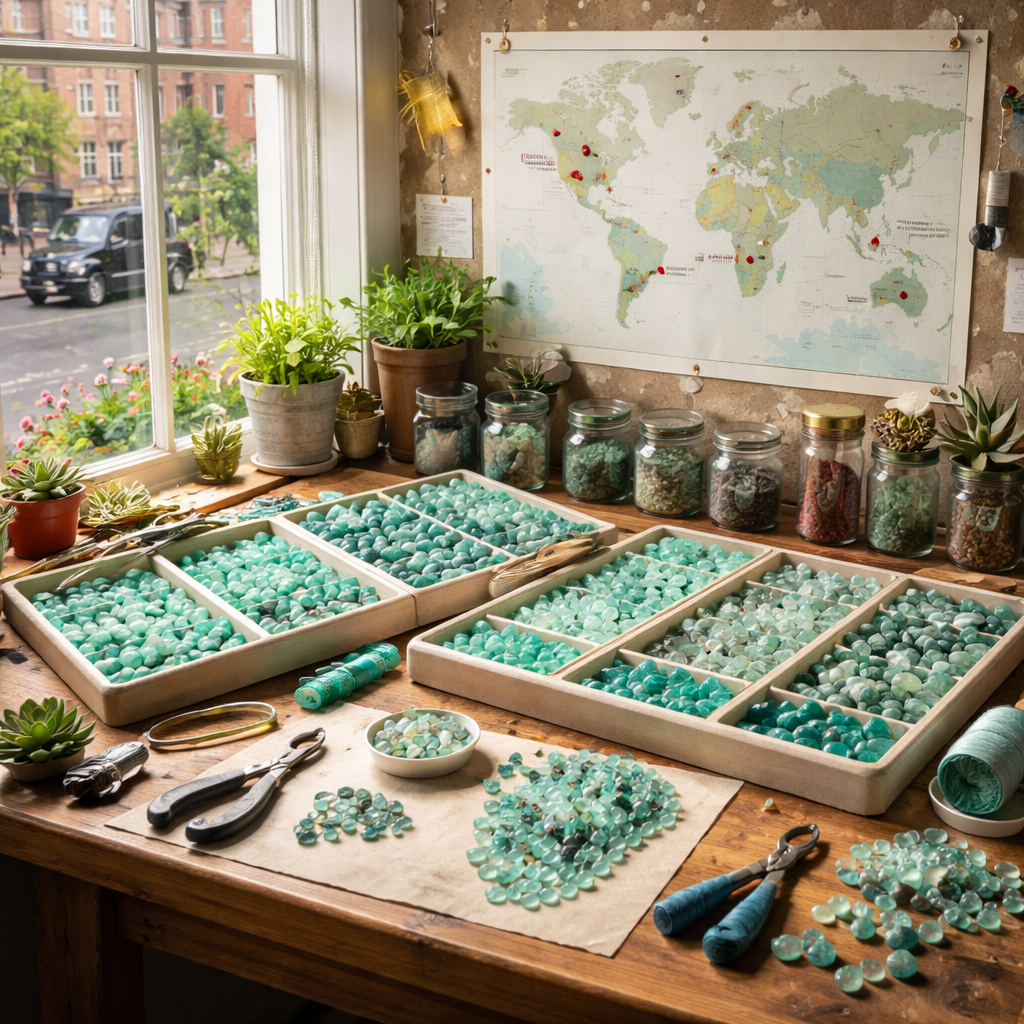
Amazonite is a striking member of the feldspar family, a blue‑green microcline that forms where granitic melts cool slowly. In pegmatites, crystals grow inch by inch, quietly developing depth and a glassy glow that feels almost calming in your hand. The colour comes from trace elements in the crystal lattice, with lead playing a significant role. But texture and crystal size matter too—the mineral’s microcrystalline matrix helps beads catch light softly, giving you that distinctive, soothing sheen that designers love.
Geologically, amazonite appears in classic pegmatite districts around the world. In the Urals, long cooling histories yield deeper forest greens that read as grounding on bold necklaces. Minas Gerais in Brazil produces brighter, mintier tones with a touch of translucence that brightens a piece. Madagascar’s eastern highlands offer speckled or mica‑flecked varieties, adding character to pendants. And Colorado’s Front Range pockets give hobbyists crystals that balance colour and form. Does origin really influence design mood? Absolutely, yes.
How are these tones created? The answer lies in tiny substitutions within the crystal lattice and the cooling trajectory of the host rock. Pegmatites crystallise late in the granite story, so they host unusually large crystals with clear, sometimes veil‑like colour bands. Lead and, less commonly, bismuth impurities push the blue‑green toward teal or sea‑glass. The result is a gemstone that’s not merely “green” but a spectrum from forest to mint. When you hold amazonite, you’ll notice light interacts differently across regions, revealing subtle depth.
For designers, origin notes aren’t ornamental; they guide how you pair gemstones with metals and how you tell your story. In our experience, Colorado amazonite anchors lines with a regional flavour, while Brazilian amazonite pairs beautifully with rose gold to warm the palette. If you’re sourcing, request origin certificates and ask about colour stability under polishing. Pro tip: seek beads cut to highlight natural colour bands rather than over‑polished surfaces that flatten character. Turquoise Amazonite Grade A Faceted Round Beads from Charming Beads can help you visualise the effect in practice.
What next? Map your collection to the stone’s colour story, verify provenance with your supplier, and let the origin become part of your brand narrative. A well‑crafted origin note can turn a simple bead into a conversation starter on a client’s wrist, and that human connection is what makes jewellery truly feel handmade.
So, what should you do next, practically? Start by mapping your designs to amazonite greens—forest for grounding pieces, mint for boho charms, speckled for rustic pendants. Check origin notes and certificates, then order a test strand to see how the hue shifts with lighting in your workshop. If it passes the eye, you’ve got material that tells a true story, not just colour.
How to Identify Amazonite in the Field
Imagine you’re out on a summer hike in the Colorado Front Range, a rock‑hammer in hand, and you spot a speck of sea‑foam green peeking from a river gravel. That moment of recognition – you’ve probably just found amazonite. But how do you know for sure?
Step 1: Look for the colour signature
The first clue is the hue. Amazonite ranges from pale mint to a deeper turquoise‑green, often with a subtle white mottling that looks like tiny clouds. If the stone leans more towards blue‑green, you’re still in the right ball‑park – that’s the trace lead talking.
For a quick visual reference, the International Gem Society notes that “amazonite colour can range from pale green to dark green and blue‑green” and that specimens usually show white mottling.Gem Society colour guide
Step 2: Check the luster and transparency
Give the stone a gentle polish on the back of your hand. A true amazonite will have a vitreous, almost glassy luster once it’s slightly polished, but it’s typically opaque to semi‑translucent. If you see a clear, glass‑like transparency, you might be looking at a different feldspar.
Step 3: Feel the cleavage
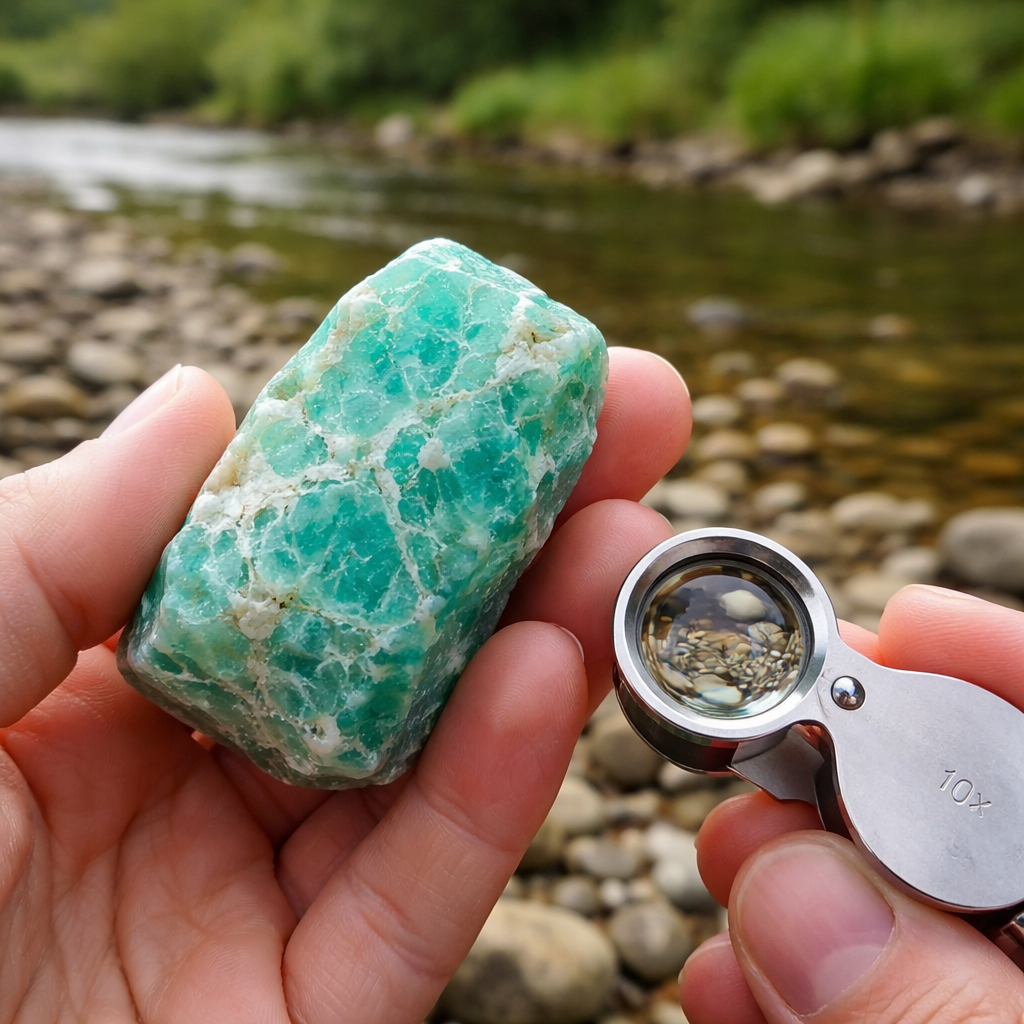
Grab a hand lens (10× magnification works fine) and examine the surface. Amazonite has perfect cleavage parallel to its crystal faces – you’ll see a faint grid‑like pattern that runs at right angles. When you tap it lightly with a metal tool, it should produce a clean, “splintery” break rather than shattering.
Step 4: Test the hardness
Amazonite sits at 6‑6.5 on the Mohs scale. Scratch it with a steel nail; if the mark is superficial, you’re on target. A deeper gouge suggests a softer mineral like talc, while no mark at all could point to quartz (hardness 7).
Step 5: Look for natural inclusions
Real field finds often carry tiny mica flakes or tiny fractures. Uniform, glass‑like colour without any speckles can be a sign of resin‑impregnated material – something you’ll want to avoid for jewellery.
When you’ve confirmed the stone, think about how it fits into your collection. A small, balanced‑tone piece from Colorado can become the star of a “British‑Made” limited edition line. For inspiration, check out our Amazonite Faceted Heart Pendant – a piece that showcases the stone’s colour and cleavage without heavy polishing.
Quick field checklist
- Colour: mint to turquoise‑green with white mottling.
- Luster: vitreous after light polish.
- Cleavage: grid‑like pattern under 10× lens.
- Hardness: 6‑6.5 (steel nail test).
- Inclusions: natural mica or tiny fractures, not uniform resin.
Once you’ve ticked those boxes, you can note the provenance on your product page – a simple line like “sourced from the Colorado Front Range, USA” adds authenticity and story value for your customers.
So, what’s the next move? Grab a hand‑lens, head to the nearest pegmatite outcrop, and start testing. You’ll quickly develop a feel for the stone’s subtle cues, and before long you’ll be confident enough to spot amazonite even in a mixed‑rock stream.
Metaphysical Beliefs and Healing Uses of Amazonite
Imagine you’re holding a smooth, sea‑foam green stone and you feel a gentle wave of calm wash over you. That’s the vibe many designers swear by when they work with amazonite – it’s not just a pretty colour, it’s a little pocket of serenity you can wear.
In the world of crystal healing, amazonite is often called the "Stone of Courage". It’s said to soothe the throat chakra, helping you speak your truth without the usual flutter of nerves. If you’ve ever stared at a blank design board, feeling stuck, a whisper of amazonite in a bracelet can feel like a tiny nudge saying, “go on, you’ve got this.”
Emotional balance and stress relief
One of the most common metaphysical claims is that amazonite eases anxiety. The soft turquoise hue is thought to quiet the mind, making it easier to let go of worry. For craft enthusiasts who spend long hours at a bench, slipping a bead into a pendant can be a subtle reminder to breathe. We’ve heard hobbyists describe that moment of “just a second of peace” when they glance at a finished piece featuring amazonite.
Because the stone is linked to the heart‑throat centre, many say it helps smooth out emotional turbulence – think of it as a gentle therapist you can carry in your pocket.
Physical healing lore
Traditional healers have attributed a range of bodily benefits to amazonite: easing muscle cramps, supporting the endocrine system, and even helping with hormone balance. While scientific backing is sparse, the anecdotal stories are plentiful, especially among jewellery makers who incorporate the stone into wellness‑focused designs. If you’re creating a wellness kit, pairing amazonite with copper or rose quartz can amplify that soothing energy.
And here’s a practical tip: when you’re setting stones for a chakra necklace, align the amazonite beads directly over the throat area. The visual cue reinforces the intention, making the piece feel purposeful rather than just decorative.
How to harness its energy in your work
First, cleanse the stone. A quick rinse under lukewarm water or a few minutes on a selenite plate resets its vibrational field. Next, set an intention – maybe “I speak my truth confidently” or “I remain calm during design deadlines”. Hold the stone in your hand, visualise that intention, then embed it into your jewellery.
When you sell a piece, share that story. Customers love a tiny narrative about why a stone was chosen, and it makes the purchase feel personal. For example, you could write: “This pendant features amazonite, a stone believed to calm the mind and support clear communication – perfect for the busy designer.”
Putting it into practice
Want a ready‑made example? Check out the turquoise amazonite beads for chakra jewellery. They’re cut to catch the light, highlighting the stone’s soothing hue, and they’re ethically sourced – a win‑win for both energy work and responsible design.
So, does the metaphysical side of amazonite really matter for your creations? In our experience, it adds a layer of storytelling that resonates with buyers seeking more than just aesthetics. Whether you’re a hobbyist looking to infuse a personal mantra into a bracelet or a boutique brand crafting a wellness collection, the stone’s reputed calming properties can be the quiet hero of your design.
Next step? Grab a few beads, set your intention, and watch how that subtle green glow transforms both your workflow and the final piece. You might just find that the stone’s gentle energy is exactly what your creative process needed.
Comparison of Major Amazonite Sources
If you're choosing amazonite for a new collection, the source matters as much as the colour. In the Urals you’ll find forest-green tones with depth and a sense of calm. It’s more than colour—it’s mood, wearability, and how the stone ages in light. That calm is why designers love amazonite for pendants and talismans every day.
Minas Gerais in Brazil brings minty, turquoise hues with translucence. These tones lift boho designs and pair beautifully with rose-gold findings. Pair Brazilian beads with warm metals to emphasise their cheerful undertones. Their chemistry adds translucence, and light may shift between batches, so provenance notes matter.
Madagascar's eastern Highlands offer speckled, mica-flecked varieties. Tiny flashes catch light in pendants and create movement. They also vary in shape—chips, rounds, and cabochons—giving options for focal pieces or understated spacers. Madagascar beads vary naturally, adding charm.
Colorado Front Range beads are smaller and balanced in hue, popular with hobbyists. They give truly ready-to-wear options that connect a British collection to trans-Atlantic vibes. This flexibility matters for kit builders. That flexibility helps you scale production.
What to look for when sourcing in 2026? Ask for origin certificates, request photographs of the mining area, and verify ethical practices. The market increasingly expects transparency, worth building origin notes into product pages now. Look for independent lab certificates where possible, and request photos showing mining conditions. Ask for batch numbers.
At Charming Beads, provenance boosts confidence and lets you price with intention. Does this matter for every piece? For many customers, yes. They want to know where the stone began its journey before it reaches their desk. Transparency isn’t buzz—customers reward clarity.
For a hands-on look at our Amazonite selection, see this collection: Amazonite Beads collection.
| Feature | Region | Notes |
|---|---|---|
| Colour | Urals | Forest-green, deep tone |
| Colour | Minas Gerais | Minty, turquoise hues |
| Texture | Madagascar | Speckled, mica flecks |
| Availability | Colorado Front Range | Smaller, hobbyist pockets |
| Ethics | Global | Certificates; transparency |
Practical design tips: choose Urals amazonite for solid pieces; bring in Brazilian beads for lighter, mint accents; use Madagascar speckled varieties to draw the eye. For new designs, order small test strands from each region to compare colour shifts under daylight and lamp light.
Checklist for sourcing: confirm country of origin on each batch; ask for certificate or independent lab report; request a batch photo and a note on treatments; verify the ethics policy; compare a sample strand from multiple regions before committing to larger orders today.
Ultimately, where you find amazonite becomes part of your product narrative, not just a supplier list. Customers respond to origins, to craft journey, and to the care you put into ethical sourcing.
FAQ
Where is amazonite found?
Amazonite is harvested from a handful of pegmatite‑rich regions around the world. The classic source is the Ural Mountains in Russia, delivering deep forest‑green stones. Brazil’s Minas Gerais produces bright, mint‑turquoise beads, while Madagascar’s eastern highlands give speckled, mica‑flecked varieties. A smaller but reliable supply comes from the Front Range of Colorado, USA, offering a balanced green‑turquoise tone. Each locality imparts a subtle hue that can shape your design story.
How can I tell which country a bead originates from?
Look for a provenance note on the product page – reputable suppliers like Charming Beads attach a short line such as “sourced from the historic Ural mines, 2026”. Colour clues help too: Russian stones lean darker, Brazilian ones are lighter and more turquoise. If the bead includes an origin certificate or a batch number, you can cross‑reference it with the supplier’s mine‑location records for added confidence.
Is amazonite from the United States a good choice for jewellery?
Yes, Colorado‑sourced amazonite can be an excellent choice, especially for limited‑edition pieces. The stones are generally smaller, giving you a balanced colour that sits between the darker Russian and brighter Brazilian palettes. Because they’re often hobby‑miner extracts, you’ll find a lower price point without sacrificing natural character. Pair them with sterling silver or brushed gold to let the subtle hue shine without competing with larger, more saturated stones.
What ethical considerations should I keep in mind when sourcing amazonite?
First, ask your supplier for an ethical‑mining certificate – many UK vendors now require documentation that proves miners follow low‑impact practices and fair‑labour standards. Secondly, prefer beads that are untreated and retain their natural inclusions; resin‑filled stones can mask poor sourcing. Finally, support suppliers who trace each batch back to a specific mine, as this transparency builds trust with UK customers who value sustainability.
How does the colour differ between Russian and Brazilian amazonite?
Russian amazonite tends toward a deep, almost pine‑green shade with occasional blue undertones, perfect for grounding, statement pieces. Brazilian amazonite, by contrast, displays a light, sea‑foam or mint turquoise that feels airy and summer‑like – ideal for boho bracelets or layered necklaces. The colour variance stems from differing trace‑lead levels in the pegmatite, so a quick visual check can often reveal the stone’s origin before you even read the label.
Can I mix amazonite from different sources in one collection?
Absolutely – mixing origins can add visual interest and storytelling depth. Pair a dark Russian bead with a bright Brazilian one to create a gradient effect, or sprinkle a few Madagascar speckles for a hint of drama. Just keep the overall colour balance in mind; too many contrasting tones can feel chaotic. A simple tip is to group stones by similar metal pairings – oxidised silver for darker tones, rose gold for lighter ones – to maintain harmony.
What should I look for on a supplier’s website to confirm authenticity?
Start with clear, high‑resolution photos that show the stone’s natural mottling and any inclusions. Look for a detailed description that mentions the mineral family (microcline feldspar) and the exact mining region. Authentic vendors will also list the stone’s hardness (6‑6.5 on Mohs) and provide a return policy for mis‑described items. If the page includes a downloadable provenance certificate, that’s a strong sign you’re dealing with a trustworthy source.
Conclusion
We've taken a quick tour of the world’s amazonite hotspots, from the deep‑green Urals to the minty veins of Brazil.
Now you know that where amazonite is found isn’t just a fact sheet – it’s a toolbox for crafting stories that sell.
If you’re a jewellery designer, match the stone’s colour to the vibe you want – darker Russian beads for grounding, Brazilian mint for breezy boho, Madagascar speckles for drama.
Craft‑makers love the ethical edge too – ask suppliers for provenance notes, and you’ll have a ready‑made paragraph that builds trust on your product page.
A quick tip: when you list the origin, keep it simple – ‘sourced from the historic Ural mines, 2026’ reads clear and credible.
And don’t forget the metal pairings – oxidised silver hugs the deep greens, while rose gold lifts the lighter Brazilian tones, making each piece feel intentional.
So, what’s the next step? Pick the source that resonates with your brand story, add a short provenance line, and watch customers linger a little longer.
Whether you sell on a boutique website or at a craft fair, that tiny note turns a bead into a conversation starter – and that’s pure selling power.
In the end, knowing where amazonite is found gives you control over colour, ethics, and narrative – three pillars that keep your designs fresh and trustworthy.
Ready to add authentic, ethically sourced amazonite to your next collection? Browse our range and let the stone’s story do the talking.
Sourcing Ethically: Buying Amazonite Jewellery
Ever held a raw amazonite bead and wondered if the person who mined it cared about the land they dug it from? That gut feeling is the first clue that ethics matters as much as colour.
When you’re scrolling through a supplier catalogue, the provenance note is your shortcut to confidence. Look for a clear line like “sourced from the historic Ural mines, 2026” or “directly from certified Brazilian farms”. If the description is vague, ask for a certificate – it’s a tiny request that can protect your brand.
Check the paper, not just the sparkle
Ethical mining certificates usually cover three bases: low‑impact extraction, fair‑labour wages, and community reinvestment. In the UK market, many wholesalers now attach a downloadable PDF that outlines these points. Keep that file in your design folder; you’ll need it when you write product copy or answer a customer’s “where is amazonite found?” question.
One practical step is to compare the stone’s colour against its claimed origin. Russian amazonite leans deep forest‑green, Brazilian tends toward minty turquoise, while Madagascar often shows speckles. If a bead looks dramatically different, it could be a treated stone – and untreated stones are usually the ones that come with transparent sourcing records.
Ask the right questions
Don’t be shy: “Can you share the mine’s GPS coordinates?” or “Do you have third‑party lab results?” Suppliers who can’t answer without hesitation are probably not worth the risk. In our experience, those who readily provide this info also tend to ship consistently and with minimal delays.
Another tip is to request a photo of the mining area. A simple snapshot of a responsibly managed pit in Minas Gerais, for example, shows you that the operation isn’t a hidden quarry. It also gives you a visual story you can reuse on a product page – a picture of the landscape paired with the bead itself feels authentic.
Choose the metal that tells the same story
Pairing the right metal with ethically sourced amazonite amplifies the narrative. Oxidised silver complements the deep greens of the Urals, while rose gold brightens the mint tones from Brazil. When you write the description, mention both the stone’s origin and the metal’s role – customers love that level of detail.
For a quick start, our range of turquoise amazonite beads comes with an origin tag that reads “sourced from certified Brazilian mines, 2026”. The tag is a tiny line on the product page, but it can turn a casual browser into a buyer who feels good about the purchase.
Build a provenance paragraph in five seconds
1. State the country and mine (e.g., “sourced from the historic Ural mines”). 2. Add the year of extraction – keep it recent, 2026 works well. 3. Mention the ethical certificate (e.g., Fairmined). 4. Tie the metal pairing. 5. End with a benefit for the wearer (“each bead carries a story of sustainable craftsmanship”).
Plug that paragraph under each product, and you’ll see longer dwell time, higher conversion, and fewer returns because shoppers know exactly what they’re getting.
Final checklist before you hit “order”
- Origin clearly listed on the product page.
- Certificate or lab report attached.
- Colour matches the claimed region.
- Metal pairing complements the stone’s hue.
- Supplier responds promptly to provenance queries.
Crossing these boxes gives you peace of mind and a story you can share with every client. Ethical sourcing isn’t a marketing gimmick – it’s a genuine advantage that keeps your designs honest, beautiful, and profitable.
